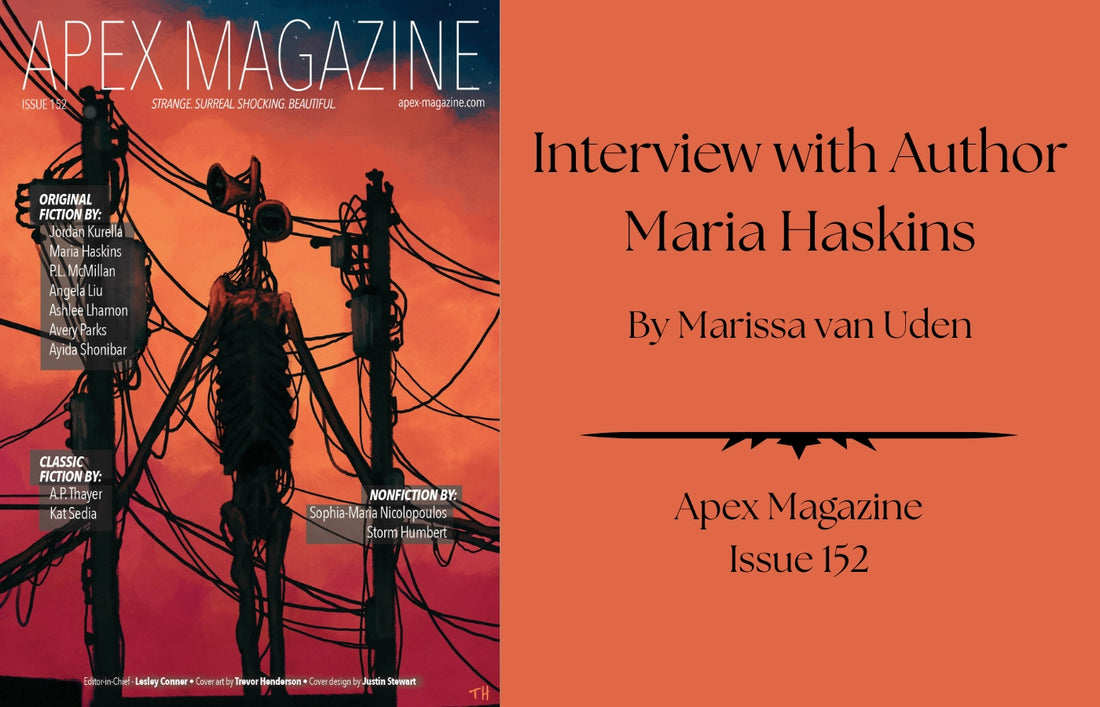
“Piglet Delivers” by Maria Haskins is the kind of story you want to go into knowing as little as possible, so if you haven’t read it yet then I encourage you to turn back now. Go and read the story before the interview so you can experience it in its most pure form.
“Piglet Delivers”—a gritty, bizzarro-world retelling of the classic children's stories Winnie-the-Pooh—asks, What if Hundred Acre Woods were a real place in the kind of world we have now, with the same kinds of pressures, inequality, corruption, and runaway development? How would the sweet creatures we know and love have fared? The answer is difficult to watch play out, because the story speaks a truth about our current age that is not pretty. It’s a dark tale, told with so much heart.
Maria Haskins is a Swedish-Canadian writer and reviewer of speculative fiction. She is a non-fiction editor at Ruadán Books, a fiction editor at Many Worlds, and she reviews short fiction for Locus Magazine.
Maria was born and grew up in Sweden and debuted as a writer there. Currently, she’s located just outside Vancouver with two kids, a husband, a snake, several noisy birds, and a very large black dog. Her work is available in the short story collections Wolves & Girls and Six Dreams About the Train. Maria’s fiction has appeared in several publications and anthologies, including Best Horror of the Year, Nightmare, Lightspeed, The Deadlands, Beneath Ceaseless Skies, Flash Fiction Online, and elsewhere.
Marissa van Uden: Thank you for agreeing to do this interview with us, Maria! I’m so excited to dig into this uniquely twisted take on Winnie, Piglet, and friends. To start with, can you tell us what inspired you to tell such a dark and gritty Hundred Acre Wood story? How did the idea come to you?
Maria Haskins: This was one of those stories that came to me, not in a flash exactly, but it arrived almost fully formed and that does not always happen to me. It was right around the time when Winnie the Pooh entered the public domain and I remember thinking a lot about that, because out of all the literary characters I’ve fallen in love with over the years, Pooh and his friends are very close to my heart. (And I am talking about A.A. Milne’s books here. I’m not a fan of Disney’s Pooh. At all.) The gears started turning in my head and almost right away I had this vision of Piglet as a truck driver with a drinking problem and maybe a bit of a drug habit. I also had this vision of a Hundred Acre Wood that had changed, that was no longer E.H. Shephard’s lovely, watercolour-tinted, idyllic landscape of childhood adventures, but an altered place where the real world, and adulthood with all its complications, had encroached. The main cast in Milne’s books are all such recognizable characters. I think we all know, or maybe we are, a Piglet, an Owl, a Rabbit, and so on. So one of the things I thought about was, what would happen to them if they found themselves in the real world?
MVU: Pooh Bear is a tragic figure in this story, and you let us see him through the eyes of his troubled best friend Piglet. I thought this choice worked brilliantly and gives us such a sympathetic but also clearly disturbed lens of our poor friend the bear. Was this always going to be Piglet’s story, and why did you decide to give him one of the main POVs?
MH: It was always Piglet’s story, right from the start. That vision of him as a hungover truck driver was so remarkably clear in my mind. I felt like I knew and understood that Piglet, and from there I just kind of hung on and followed him wherever he might go. In the books, Piglet is a very anxious and Very Small Animal. He is also much more aware of, and worried about, how others perceive him than Pooh is. Pooh has his own anxieties, but he has a kind of oblivious confidence in himself and his ideas, while Piglet always worries both about being small and scared, and also about being perceived as small and scared. With all of Piglet’s fears and self-doubt and anxiety, I knew that he would be an interesting character to follow around an altered Hundred Acre Wood.
MVU: Another POV character is Kanga, who is now a hardened and cruel creature. But she’s no one-note villain; you’ve given her complexity and layers. Although she is engaging in some literally shocking behaviors, we see glimpses of her own deep wounds and loss, and see how pranks that might have seemed adorable in the children’s books, like when Piglet and friends abducted her baby Roo and replaced him with Piglet, ended up scarring everyone involved. Can you share a bit about creating this character and why it was important to show these sides of her?
MH: As a child, I really disliked Kanga. Roo annoyed me as well, but especially Kanga. She just rubbed me the wrong way. I still dislike her as a character, and as an adult I’ve thought a lot about why that is. For one thing, Kanga is the only female main character in the Winnie the Pooh books, so I do feel somewhat guilty for singling her out as the villain (though Roo is no dreamboat either). Kanga is also the only character that is a parent, and I think that, to me, is one of the main reasons why she feels somewhat out of place in the story. And yes, the “switch-a-roo” prank in the book is such a terrible and traumatic episode for everyone involved. Rabbit hatches this awful scheme to abduct baby Roo, gets Pooh and Piglet on board, and then Piglet gets stuck with Kanga who punishes him with a cold bath and a stiff brush before she lets him go. Much as I dislike Kanga, that was a terrible thing to do to her, and when I started writing the story, I knew a) that Kanga would be the villain, and b) that the memory of Roo’s abduction would play a major role. The way I imagine her is that she is a lot more capable and clever and practical than anyone else in the Hundred Acre Wood. And when it became necessary, she used her skills and capabilities in ways that might have started out with some kind of good intentions, but became rather twisted and nefarious over time.
MVU: There were a couple characters that had smaller roles in this story but big impacts. One of my favorites was your version of Eeyore, who I was so pleased to see is utterly unstoppable. I was also intrigued by Christopher Robin, whose memory haunts the creatures he left behind. This story feels bursting with history and secrets from the past. Do you think we’ll ever see more tales from you from within this same universe?
MH: I love Eeyore, and in my opinion, there cannot be a Pooh story without him. He had to be there and I also knew from the start what he would be like in this world. And yes, the absence of Christopher Robin is the unexplored trauma that haunts everyone, from Piglet to Kanga. What happens when the person who made you come alive and narrated your world into being disappears? I think many of us have some experience with what it feels like when you lose a person who made you feel alive, who brought people together, who was the center of your universe. In the context of my story, Christopher Robin stopped playing with Pooh and the others. He left them, and whether it was because he grew up or something else doesn’t really matter to the creatures left behind. As for future Pooh tales, I do have some ideas which may or may not include Tigger, a character I find even more annoying than Kanga.
MVU: Ha, amazing! I can’t wait. I know I’m going to enjoy reading about the Hundred Acre Woods characters you find annoying just as much as the ones you love. Speaking of human-animal friendships, I adore stories about anthropomorphized animals, because when written well they can be so profound. As with all good fantasy, it becomes a more honest way of seeing the world, subverting the bizarre but common assumption that animals lack emotional interior worlds. In your heart-wrenching story “Down to Niflhel Deep” (published in Kaleidotrope and also available in audio at PodCastle), about a dog’s undying love for his girl, you told the story from the dog’s perspective. I loved this story so much. Can you talk a little about the inspiration behind the story and perspective, and about what nonhuman friendships mean to you?
MH: That story was inspired by my daughter’s relationship with our old dog, Jake. She was 6 when we got him, and they had a connection that was very special. They shared a birthday, for one thing, and he always knew when she needed him. It’s been a few years now since he passed, and we have a new wonderful dog in our home, but I miss Jake every single day. He passed away very suddenly, and I wrote about that in an essay for The Deadlands, “A Dog, a Heart, a Box of Ashes, or Whom Rhodope Shed Tears For.” Animals have played a big role in my life for a long time, and I think that dogs especially have a bond with humans that is almost a form of magic.

MH: Our dog Henry in our king size bed (my favourite reading spot).
MVU: Oh my gosh, thank you for sharing this. I had missed this piece but it’s one of the most beautiful essays I’ve read, and so real. I wish this history was the kind of thing we taught ubiquitously in schools, with as much weight as we’d teach about nations, religions, or any other subject. That bond really is magic and a part of who we are.
Another story of yours, “The Darkness Carried by the Beasts” (originally published in the The Sunday Morning Transport and reprinted by PseudoPod in 2025), is a sublimely beautiful exploration of loss, death, and love, highlighting the bonds we have with our loved ones, our animals, and wild animals as well. In the intro, you mention that the story came to you first as an image of the man and his dog in the snowy woods somewhere in northern Sweden, and that Chernobyl was another inspiration. Could you tell us a bit more about how this story took shape. Were you surprised by where these initial images took you?
MH: Like so many of my stories, that story started with a scene and an image. This time it was a man lost in the woods in a snowstorm that blots out the world around him. That story is special to me for a lot of reasons. It’s set in northern Sweden where I grew up, and like the man in the story, one of my maternal grandfather’s jobs was to go out in the woods and track down moose and other animals that had been injured in car accidents. The man in the story is not really based on my grandfather but that was part of the inspiration. Another inspiration was Chernobyl, of course. I was a teen when it happened and it was such a huge event in Sweden. It haunted everyone for years with warnings about eating berries and mushrooms and wild game and this feeling of things being poisoned.
What surprised me when I wrote that story was the way it fought back. I tried to make it go in a few different directions at the end, but I could not get it to work. When I finally found the right ending, it was a lot quieter than I had expected.
MVU: There’s something you do in your stories that I absolutely love, which is to leave negative space between the details. You give us just enough to understand what’s going on and give every line a richness, but there’s always a little held back, hidden just out of sight, a little more to know and draw us in. What parts of your writing or editing process do you credit to achieving that effect? Do you take your stories through many drafts before you feel they are done?
MH: Thank you so much! That is one of the best compliments I’ve ever received for my writing. I do like to say less rather than more. It’s one reason I love to read and write flash fiction, too: that challenge of telling a story with as few words as possible without losing anything. A lot of my writing process after writing a first and second draft is removing the extra bits that I feel aren’t really needed to tell the story. This means that I write a lot of drafts. SO many drafts! Luckily for me, the editing process is my favorite part of writing. Getting a story out in all its messy first glory is hard for me. Working through it after that to chop, carve, shape, and move the bits around, that’s what I love the best.
MVU: It’s not a popular opinion but editing is my favorite part too! That process of tinkering and carving is just bliss. I often ask writers about their writing spaces and habits, but I’m just as fascinated by favorite reading places and rituals. As someone who reads so much fiction, do you have favorite spots in the house (or holiday spots) where you love to read, or a favorite weather or time of day to dive into a book? Any rituals to create a good reading session, like certain teas or music?
MH: I read a lot. I am a voracious reader from a family of voracious readers. I read in bed before I go to sleep every single night. I read whenever and wherever I have a moment to read: on my phone, on an ereader, or (sometimes) an honest to goodness ink and paper book. My favorite places to read are in bed, on a train (I get so much reading done when I’m on a train), or sitting on the porch of my parents’ place in Sweden, but I will read anywhere.

MH: Me at my desk from two years ago.
MVU: This year, you took on some exciting new roles—as the senior columnist and non-fiction editor at Ruadán Books and a short-fiction reviewer for Locus Magazine. Can you tell us a bit about your new positions: fun new skills you’re learning, interesting challenges you get to tackle, or just your favorite parts of the job?
MH: Writing for Locus is a dream come true. I’ve been reviewing short fiction online for various venues since 2015, and I am thrilled to have the opportunity to do it for such a first-class publication. To get the space to wax poetic about stories I like is a treat and a privilege. The nonfiction editing job was a new challenge. R.B. Wood at Ruadán Books brought me on board in early 2025. My main job is as editor of the Thoughts From the Writer’s Desk feature. When I started, I wasn’t sure what kind of essays I would get, and it's truly been a revelation to read the submissions. The breadth and depth and quality of the essays we get blow me away. Everything from personal meditations on the intersections between life and the craft of writing to writing advice from writers I admire and incisive pieces on dark fiction and horror. I’ve also found I love the editing process. Maybe that’s not a shock since I love editing my own work too. I just really like the collaborative conversation you can have in editing.
MVU: I like to wrap up our interviews by asking authors for a charity they’d like to raise awareness for. Could you share a little about a charity that’s meaningful to you and let readers know where to find it?
MH: My chosen charity is Greyhaven Exotic Bird Sanctuary: greyhavenbirds.com. They care for parrots in need and try to find caring homes for them. I’ve volunteered with them and I also worked for them part time until recently. They do an amazing job taking care of these intelligent, demanding, and wonderful animals and if you can support them, please do!
MVU: Thank you so much for spending time with us today! As a final note for our readers, do you have any upcoming publications or exciting projects in the works that they should look out for?
MH: Yes, I have a story coming this year in Experimental Files, an anthology of short stories inspired by the work of Gemma Files. I’m ridiculously excited about this anthology and excited to share my story “Distant But Unmistakable” with the world. It’s a horror story set in Sweden, and it was inspired by a story my grandfather told, VHS tapes, and by the kids’ show Yo Gabba Gabba.